The concept of the compliment is pretty easy to explain. It's usually given to someone you care about that deserves praise or accolades for doing something ordinary in an extraordinary way. In the case of the performer (actor, musician or otherwise), most of them are short and straightforward, like "you're awesome", "you rule", "you're incredible" or perhaps simply "I like you... I like you, a lot". Though I wonder, have you ever truly paid someone a compliment? I mean, the ones that go deeper than the ones you see above. The kind of compliments where you communicate a sense of understanding and deep appreciation, for both their presence in pieces of work that you love and their dedication to their talent. In doing so, you honor the person you are complimenting and yourself.
To that end, let me tell you a story. I went to Ohayocon 2009 about two months ago. It was the first anime convention I ever went to and, as expected, it was rather crazy. In the middle of this madness, I was on a mission which involved an actor named Caitlin Glass. Caitlin Glass is a lovely and talented voice actor/director who mostly works for Funimation Entertainment as well as some occasional ADV Films projects. Although I hadn't seen her in very many things yet, she had already captured my attention from her performance as Winry Rockbell, in the anime "Fullmetal Alchemist". I knew that if she was at this convention, I was going to give her my regards if it was the last thing I would do.
So at 5:30 PM, I arrived at her "Ask Caitlin Glass" panel, ready and waiting. She was a little late and flustered when she arrived, notifying us that due to poor scheduling the panel had to be shorter than most voice actor panels. For you see, she had to attend the "Ouran High School Host Club" panel, an anime which she directs and plays the lead character, Haruhi Fujioka. After waiting for several people to get in their questions first, I was ready to give it my all. I knew that in the spirit of the panel being shorter, I had to be as hasty as I could. I raised my hand and after one other question, I was called.
I shall recount what I said the best I can, as well as add some annotations that I didn't get to say.
---
I have a tremendous affinity for voice actors. Voice acting, to me, harkens to two things. One is silent acting, which is essentially the inverse of voice acting; where the actor shows their entire history and emotional complexity from the look in their eyes and the expression on their face. Whereas in voice acting you bring out the history and complexity through the way you speak a line. On that level, the other thing voice acting harkens to is singing, which deals in the same principle. There is a sense of sincerity in the way you sing or the way you speak if done well. To that effect, I want to tell you when I fell in love with you as an actor. In "Fullmetal Alchemist" you play Winry and there is a specific scene that stuck with me. I don't know if you remember this or not. It's in episode 26 (Her Reason) and it's the scene where Winry is sitting in a hotel room with Ed (Edward Elric) after she had just repaired his automail. She asks him whether or not he can come back to Resembool (the respective hometown to both of them) to see if she can update her work on him some more. He thinks for a second and decides not to do it, he'll pass for now. After this answer she bows her head in sadness and she says quietly, "Haven't you been satisfied with my automail, Ed?" When you say that line, you say everything. You are emotionally pure and open in this moment. The question itself is not about whether her work is good or not, it's more about the hurt you feel for him and his brother Alphonse, and the loneliness you feel without them. These are two people who lost their mother and are continuing their lives as if they are the only family they have; but you've always seen these two as your family along with your grandmother, Pinako. You want to take care of them, give them a home and relieve them of their hurt as well as your own; you want to help but they either refuse or don't listen, especially Ed. You have a deep love for them and you hurt with them, but you're still faraway yet so close to them. Only a great actor can show that much emotional depth by doing so little. So I have the utmost respect and honor for you because of that.
---
As I said these words, which I had spoken in my head many times leading up to this, I was looking at her. She was visibly moved by what I said and soon after my finished she agreed with what I said and started talking about how personal it was to play Winry. At that moment, I felt so accomplished. I had given someone I respected something really personal. At that moment the dichotomy wasn't performer and fan, it was a level of mutual honor between two different but similar individuals. It was beautiful. I later received an autograph and a picture from her while I told her about how these words were one of the main reasons I came to the convention in the first place. This knowledge made my words move her even more.
This experience is exactly what a compliment should entail. A moment where you let someone you like know that you were given something so special from the simple words of a performer, courtesy of their talent and their acute awareness of humanity.
Thanks, Caitlin.
---
Oh, I almost forgot to mention, she's a beautiful singer, too.
Cherry blossoms are in full bloom and falling along the paved landscape, leading down the street to where two train tracks lie, together but apart, going in opposite directions. A man walks along this road he has been down many times before and knows instinctively that he must cross the track in order to continue his desperate contemplation. On the other side of this marker is a woman walking along the same pathway who approaches the track with the same thought and purpose. As the man and woman pass one another as they are crossing, a quiet jolt of emotion comes back. Was that the girl he once knew? Was that the boy she first loved? They keep walking apart silently until they reach their respective other sides. As the caution signals come down they both remain still, not really sure of what to do next. When they slowly begin to turn their heads to look at one another, a train passes by with surefire precision. The man waited until the train had passed, but by then, she was gone. Faded into memory.
That subtle but powerful image captures the tone of the film "5 Centimeters Per Second", a melancholy portrait of human longing by Japanese animation auteur, Makoto Shinkai. The movie tells the tale of Takaki Tōno (David Matranga) and his lingering love for Akari Shinohara (Hilary Haag), a childhood friend of Takaki's. They initially meet through attending the same school where they are new students together. Soon they realize that they each have similar interests and vibes and begin spending more time together. The other students tease, but their bond cannot be broken. Unfortunately, both of their parents have very transient jobs which forces them to move farther apart from one another. Slowly and surely, they drift out of each others' lives with no word of closure between them.
The film is structured in three distinct acts. The first, "Cherry Blossom", deals with this recounting of how the two of them met, as Takaki takes a train ride through treacherous cold weather to go to see Akari before she has to move further away from Takaki. The second act, "Cosmonaut", is mostly told from the perspective of another woman from Takaki's high school named Kanae Sumida (Serena Varghese). She has an undying love for Takaki but cannot find the words or courage to express it to him; all this while he deals with an ever greater physical distance from Akari. The third and final act, "5 Centimeters Per Second", deals with Takaki's present adult life, showing him as an emotionally stunted man. The couple's history in between that time is told through a beautiful and lyrical montage which ultimately, reveals him as lonely, untouchable and detached from his own life.
---
One narrative motif in any of Shinkai's films is the written word. From either a handwritten letter to text messages through a cell phone; these simple words and thoughts recur through his characters' minds constantly like a lifeline to save them from drowning in their own numbness. This is featured most prominently in the first act with Takaki, in addition to trying to meet Akari, carrying a letter that he feels he must give her. Again, due to the terrible weather, he loses the letter in the harsh winter windstorm and never delivers the note he wrote. However, at the end of the act, you see that she had her own letter for him but it was never given or received. By the end of the film, you could make the inference that the young woman's letter was not a happy one.
One of the saddest observations I have noted in my life is how much damage can be inflicted by one person on another. Not in the sense of physical violence, yelling, or actual abuse. No, the pain that can be done to the human heart through quiet subtle acts of rejection or ever worse, indifference. These are the things of lifelong hurt and regret. I had two such instances in my life that were called to mind by this film. In one, I was "spared" by the honesty of a young woman who rather quickly met my courtliness with a letter that declared her intention to remain friends. This, while savage in its own right, at least spared me years of longing which would have the danger of repeating a harrowing previous experience.
At one point in my younger years I became infatuated with a young lady, one smart, charming, lovely and kind; her name was Elyse. I held her in the highest regard for years, always showing her the utmost respect and well, love. She kept me somewhat at a distance, but I thought nothing of it, a good amount of people did anyway. Unfortunately, nothing prepared me for the mental car crash that awaited me. Several years after the infatuation began, I attended a school social, hoping to encounter her there. Sadly... she arrived on the arm of another man, a fellow classmate I might add. Although I was upset with the classmate who accompanied her, Elyse made me feel a low I never felt before. I felt so used and cheated. All that wasted emotion, and for what!? For a searing emotional scar, given to a heart that had been through enough alienation by his fellow peers. Nary a word crossed between us that night, but I live with the hurt of it still; shy to ever put forth so much of myself in an uncertain world towards an uncertain female.
Our actions are not only defined by what we do, but what we don't do. In the case of the film, what would have happened if Akari gave the letter to Takaki, like the woman who gave me the same letter years ago? It would hurt, but maybe, just maybe, he could have moved on and found happiness again, maybe with Kanae... but we don't know. As human beings, we have this terrible habit of thinking we know exactly what's right for the other person regardless of emotional truth. This is a problem I deal with as well and I hope to get better at understanding that concept. The truth may be harsh but it's better than owing an emotional debt we can never repay.
---
I made this expression on the film, mostly based around the third act. I'm proud of it and I hope to improve my craft in future works.
The first seven minutes of the anime series "Elfen Lied" revolve around a woman escaping from a secret government facility with calculated, deadly precision. Using only her mind, she stops bullets, lops off limbs, hurls sharp objects through flesh and decapitates helpless guards and staff members, all while she is naked, I might add. I sat back with rather piqued interest. I had heard the praise and accolades for this show as the premiere horror anime and I was ready to be astounded.
"Elfen Lied" tells the story of a young girl named Lucy (Kira Vincent-Davis). She is a Diclonius, an evolved form of human that have horns on their heads and mental vectors with the shapes of arms and hands that can do their bidding. When Lucy escapes from the government facility where she is being held, she gets hit in the head by a rouge bullet and develops another personality. This second personality is named Nyū (also voiced by Vincent-Davis), a childlike girl who doesn't have a huge vocabulary, does have an infinite curiosity of the world around her and possesses no knowledge of what she's really capable of. Nyū is found by a young man named Kohta (Adam Conlon) and his cousin Yuka (Nancy Novotny), who proceed to lodge her in Kohta's newly acquired, spacious house (it was formerly a restaurant).
I was looking forward to finding this anime a powerful and emotional experience. What ultimately transpired was one of the most disheartening and dejecting experiences I've ever had watching the visual medium. Now I've heard most of the negative complaints about the show, most of which aren't very drawn out. So I feel that I must get my two cents in, for the sake of my own sanity and to give a proper voice for the dissenters of the series.
---
I feel most film and TV is a two way conversation. The art presents a story which has certain elements which invoke certain things in me. That in turn allows me to interpret the story in my own way using elements of my own life and the world around me as inspiration. There are some cases where the conversation is one-sided, but it's left in the hands of the viewers. A good example of this is Robert Bresson's 1966 film "Au Hasard, Balthazar," which tells the story of a donkey with numerous owners in its lifetime, some good and some evil; but the film itself refuses the luxury of having the characters emote. This leaves the viewer to fill in the emotional blanks themselves, making it a much more difficult but more personal viewing experience.
The worst type of stories are those where the conversation is one-sided but it's led by the story, brandishing a shotgun and forcing you to go a certain way. This is one of the main problems of "Elfen Lied." The story and atmosphere of the show are diametrically designed to make you feel sorry for the Diclonius, hate the bad guys and admire Kohta and Yuka for taking Lucy and the rest of her kind in his (Kohta's) house.
The most prominent way this feeling is achieved in the show is by portraying humanity in a very negative light. The Diclonius themselves are not generally known by the public since they're being bred in secret, but whenever a Diclonius interacts with a typical human being, they either get berated, whispered about or treated snottily. When a younger Lucy falls down to the ground, she is yelled at to stand up because she is blocking the road. When Nana (Sasha Paysinger), another Diclonius, is trying to figure out how to buy some food, she's treated with very little respect just because she doesn't really know what to do. While she walks away, two girls whisper about how dirty and unclean she looks. These facts wouldn't bother me so much, since humans are not necessarily the nicest of species, if it didn't pertain to almost every single normal human on the show. Sadly, it does just that.
This is further compounded by the fact that most of the men on the show are either jerks, misogynists, moral deviants, sexual deviants or any combination of those traits. Besides this fact offending me emotionally, this offended me as a man. Consider the operative character, Bando (Jason Douglas). In the first scene you meet him, he's pleased at the prospect of being able to just kill someone without question and knocks the lights out of a poor woman who was just walking behind him, calling her a bitch. The magna, the source material from where the show is based, has a supposedly more three-dimensional treatment of him, but I guess the creators of the show thought it was a bad idea to make him nothing more than pure, angry testosterone.
This is also true of many of the more knowledgeably capable people on the show, including many of the scientists. One of whom has a scene where he has Nyū naked and chained with intenstion to rape her, with full knowledge that she is also Lucy. This leaves the "good guys" without very many natural resources, thus leading them to become slaves to the plot. Things happen to them, they don't implement.
Another story to consider is the backstory of Mayu (Cynthia Martinez), a young runaway who lives in a storage area on the beach outside of town. Once again, it should be noted that I don't hate tragic backstories. If you count how many times an anime character's parents have kicked the bucket, you're going to need more fingers and toes. When they showed how she was molested by her stepfather, however, I felt sick. Not just because of the idea of molestation, which is sick in itself, but how explicitly they portray her getting violated. They literally have a young naked girl, with her head down and on all fours. It just reeks of desperation and exploitation.
The greatest straw breaking moment is one that many fans and non-fans talk about a lot -- the puppy. Yes, the puppy. During a flashback we see Lucy befriend a puppy as her only friend since she isn't really liked at her orphanage. Unfortunately, her fellow orphans (her tormentors) find out about the puppy and proceed to beat it to death in front of her (offscreen, but still) for their amusement.
The root problem with the emotional core of the series is that it doesn't seem to trust my emotional intelligence. When I start watching something, I'm ready to empathize and care about the characters onscreen. When you start feeling like you're being directed to feel a certain way at every moment however, it stops becoming an organic emotional experience and starts becoming a dirge.
---
Suspension of disbelief is an aesthetic of art where the audience believes elements of a plot to be true even though they are outlandish or impossible; I, myself, practice this theory a lot. Not everyone is that willing however. Take my Dad. He has one of the sharpest disbelief sensors I know and he will openly criticize any piece of work when it jumps the gun. The biggest rule of his is if the story is taking place in the real world, you accept a certain fantastical fact at the start of the story and see if the plot stays true to both the real world and the fantastical fact.
Another huge flaw in "Elfen Lied" is that the environment surrounding the series doesn't pertain to how normal human beings would react. When the series started I could understand the idea of a government holding a special laboratory to create new human-based weaponry (a great example is from the film, "The Manchurian Candidate"). I could also understand the local police department being paid off to make sure that the town doesn't know that crazy government dealings were being done not too far from their homes. This whole setup comes crashing down when Lucy escapes. After that happens, I started wondering why there were no characters of any sort who were curious about the recent acts of violence.
What I would have liked to have seen was a cop who is wondering why his department doesn't seem to care about why his own force has been so busy and secretive. Either that or a newspaper reporter who realizes the correlation between the events now and the events eight years before the Diclonius Project started. Or how about a government liaison who starts wondering why this project he doesn't know about seems to be having problems in its area of location?
Why doesn't this series even allow for simple human curiousity to bring an outside perspective into the game? Once again, this lack of general logic purposefully casts humanity negatively and controls the viewer's feelings by marionette strings.
---
Both the overcompensating emotion and intermittent logic of the show ultimitely converge to the singular biggest problem of the entire story: the Diclonius themselves.
Their "dilemma" reminds me of Fritz Lang's 1931 masterpiece, "M," which tells the story of a man named Hans Beckert, played by Peter Lorre, who wanders the streets and kills innocent children. For most of the movie we are very convinced that he is guilty, but then a strange thing happens near the end. Hans explains to a group of angry criminals about how he's driven by an uncontrolled mental compulsion until he kills again. Now this doesn't make him any less guilty, but it paints a more complex emotional landscape. It starts raising questions: Is he pure evil or criminally insane? Is he mentally ill or directly motivated? These questions are part of the complex scope of humanity.
With theDiclonius however, their violent nature is ingrained in them. They understand perfectly well that they have vectors and will not be afraid to fight or kill whenever necessary or unnecessary. This includes the emotionally calmer Nana, whenever she battles Lucy to try and bring her back to the facility.
I've heard that the Diclonius represent the struggle between nature vs. nurture, but even that argument is flawed. I personally believe that we are capable of any emotion we can set our minds to, because the entire emotional spectrum is innate within us; that is our nature. What happens then, is how we consciously or subconsciously process the events of our own lives. This translates into how we act. Some have the power to change, some can't, but the most important aspect is that we almost always have the choice to ourselves.
Once you remove the choice, you ruin the moral complexity of the dilemma. When Lucy starts killing at the young age she does, it's activated by a mindset already inherent within her. It was bound to happen sooner or later. It can't be changed. It makes me think of those people who believe that Autism is a disease that can be cured...
Let me explain something: Autism is not a disease, it's a disorder. It can be stabilized, not cured with a shot like a virus.
Also the main violent vendetta placed by the Diclonius to kill the human race is logically unsound. The main issue is that once all humans are extinct and they still have that violent tendency, who's left to kill? Each other. The Diclonius are forever in a vicious cycle leading towards their own self-destruction.
With this knowledge, the series seems to make a point, whether intentionally or not, that the Diclonius would be dangerous to be left alive and should be killed. Now, I can already hear the word hypocrite being shouted at me for being in similarly mistreated group of individuals. Autistics have had their share of troubles including centuries of little understanding of mental disability to them being thrown in asylums and given LSD for experimental purposes during the 1960's. (Since when is giving hallucinogenic drugs to neurologically unstable children ever a good idea?)
So why should I defend one group of sufferers but criticize another? Well, there are two main differences. Firstly, no autistics are trying to take over the world and it would be quite hard for us to attempt since 75% of us are mentally retarded (I am one of the lucky few who is not). Secondly, we and many others have crusaded peacefully for our existence leading to studies, treatments, laws, education programs and international exposure; all because people can actually care about others, which is something "Elfen Lied" has a hard time grasping.
Ultimately the series made me feel used and manipulated, both mentally and emotionally. If that's what it was going for, then yay for you, but I'd rather leave with some shred of human dignity first.
---
After reading my more rational criticism, this is my revenge...
P.S. Any flaming regarding this video would be redundant since what you would like to do to me is represented at the end of the video.
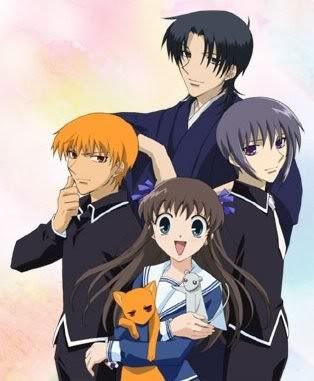
(Clockwise from Bottom: Tohru Honda (holding Kyo's and Yuki's animal forms), Kyo Sohma, Shigure Sohma & Yuki Sohma)
"Fruits Basket" is an anime that tells the story of a teenage girl of 16 named Tohru Honda (Laura Bailey), who becomes a tenant and housekeeper at the home of three brothers of the Sohma family: the calm and collected Yuki (Eric Vale), the angry and volatile Kyo (Jerry Jewell) and the mannered but juvenile Shigure (John Burgmeier). She then learns of an ancient curse placed on the family where each member is turned into an animal from the zodiac if they are under heavy physical stress or embraced by a member of the opposite sex. Most of the time when people learn about the curse, their knowledge of such is erased, but Tohru is trusted with the secret. So, Tohru spends her new life learning and understanding the Sohmas.
There's a fascinating dexterity in the relationship between the Sohmas and Tohru. On one hand, you have a group of very different personalities consistently crashing into each other; in most cases, multiple times in the same day. Kyo and Yuki are constantly at each others throats, while Shigure sits calmly in the back commenting on the situation. Sometimes he even fans the flames, just to amuse himself. Except for when the doors of the house need to be rebuilt because of their tendency to be broken during these arguments. (This happens quite a lot, actually). That's not even counting the rest of the Sohmas, who are each intensely emotional in their own way. Considering that Tohru herself is not a very socially adept person, she tries to diffuse various situations but usually fails. So there's a great amount of high comedy as we watch vicariously in the same position as Tohru; wishing we could resolve these clashes, but not knowing how. The very premise of the show itself is very much a type of sitcom premise: a normal person moving into a house of crazies. (That never means it can't be original though). Above all, despite their constant butting heads, they are, in fact, a family.
On the other hand, there is a really sad undertone running through the series. Because of the fact that the Sohmas have this curse, they tend be very closely guarded people, often to each other. Every Sohma family member has a deep pang of disappointment in their history of relating to others, ranging from over-protection, outright rejection, or trauma on the receiving side.
Kyo in particular has the curse of the cat, whereby he is forced to be an animal that is not even part of the zodiac; this includes a demonic cat form (which, by the way, looks like a cousin of Frank the Rabbit from "Donnie Darko.") Therefore he is treated like an outsider in his own home. Along with this, Kyo uses his anger to keep people at a distance because he feels that no one will ever accept him as he is, not even his own family. Like many teenagers, he looks out for number one. To contrast, Yuki is a very shy introvert. He is indeed popular at school, where he is called Prince Yuki. Through it all though, he finds the popularity overwhelming. His classmates are in love with the ideal, not the person. Believe me, I know how that feels. He also has a very edgy relationship with his own brother Ayama (Chris Sabat) and was psychologically stunted by the abuse of Akito (Chad Cline), the head of the main house.
Considering the fact that Yuki and Kyo are the rat and the cat, respectively, they have been in a lifelong battle against one another since childhood. Kyo hopes the day will come when he can beat "that damn rat." Yuki shrugs it off nonchalantly, knowing that he would best him easily if they did compete against one another. Kyo believes that when he beats Yuki, he will have proven himself to his family. Yuki, conversely, is somewhat envious of Kyo. Even though Kyo is hostile, he is actually one of the more naturally extroverted members of the Sohmas. So when Kyo gets in a group, he usually eases in pretty quickly despite some protest. This peculiar envy of Yuki is contrasted by Kyo's own envy of wishing to belong in the more closed off realm of the family.
With all my talk about the Sohmas, I haven't even gotten to Tohru. She reminds me of the idea that sometimes a person with the sweetest smile on his or her face is actually one of the saddest people around. Let's elaborate: her dad died of pneumonia, her mom died in a car accident and she's treated rudely by her extended family. (Only her grandfather gives her any respect). At the start of the series itself, she's living in a tent in the woods because her grandfather's house is getting renovated and she doesn't want to be a burden on her protective and caring best friends, ArisaUotani (ParisaFakhri) and Saki Hanajima (Daphne Gere). Shortly after meeting the three Sohma brothers, her tent is buried in a landslide, so she relents and takes the offer to stay at the house.
Despite this heavy tragedy, part of what makes this series great is Tohru's hopeful personality. Her constant optimism in the face of adversity is like a beacon of light in a really dark room. She refuses to give up on accepting the Sohmas for who they are and is emotionally open to each family member's baggage. Most of this mindset comes from her mother, who taught her many lessons about people and life before she died. These lessons often appear spoken through Tohru or in simple flashback stills. Aside from all that, we as an audience would not empathize with Tohru unless she was performed exactly right and she is. Laura Bailey plays Tohru with sensitivity, grace and care. Personally, I find this sort of surprising since the only other role I've seen her play was Lust from "Fullmetal Alchemist." What a switch!
Ultimately, the series is about people relearning to be people, where the characters let their emotional guards down so they can finally complete one another, for their own sake.
---
The events in the final two episodes of the series involve Tohru finally seeing Kyo's demon cat form, which marks the most difficult test of acceptance in the show. Inspired by the events in those episodes, I've created a short film (expression, soul poem, AMV, whatever you want to name it...) using the song "Angels Too Tied to the Ground" by U2. The piece is entitled "Pain Toward Healing (Acceptance)."
Let's face it: It's common in fiction to have the main character be the person who needs his or her friends to face a problem. That doesn't mean that supporting characters in a story aren't allowed to have problems of their own or allowed to be three-dimensional. It's just that most storytelling revolves around how our hero is in a pickle and how the others have to get him or her out. But isn't it interesting when a story decides to have the main character's problems be the basis of helping someone else with a much worse problem?
"Haibane Renmei" tells the story of a young girl named Rakka (Carrie Savage) who starts her new life born as a Haibane, which means "Charcoal Feather," in a place called "Old Home" headed up by Reki (Erika Weinstein) along with her fellow "older" Haibane, Nemu (Kristy Pape), Hikari (Hunter MacKenzie Austin), Kana (Zarah Little) & Kuu (J-Ray Hochfield). The Haibane themselves are mystical humanoids who have wings and halos but are not angels, so go figure that one out. They live in a walled-off town named Gile where every Haibane works in the community for the appreciative majority human populous. That is until their "day of flight" comes and they are allowed to leave the town and its walls.
When I look at Gile, it reminds me of Judgment City from Albert Brooks' 1991 film, "Defending Your Life" for a couple reasons. Gile, in itself, is not a nasty urban town where everybody's rude and stupid. The town and its inhabitants are mostly really friendly and accepting of the Haibane. Haibane don't even have to pay cash to the townspeople; instead, they inventory each transaction in a little book given to them by the Toga (the guardians of the town). Some Haibane don't get along as well between each other, but that's really the extent of the nastiness of that community.
Like Judgment City, Gile seems to function as a sort of Purgatory. Only the Toga are allowed to enter and leave the town at will and if a Haibane tries to leave the town before their "day of flight," they get punished. Rakka, herself, gets a hardcore fever at one point for just even touching the walls (the walls are really cold).
Also, like Purgatory, every Haibane has a personal and metaphysical quest they must follow based on a dream they have before they are born. When they understand the dream, they can understand an important part of themselves. Unfortunately, if you become lost in your quest and become spiritually despondent, you become sin-bound, and if you remain so past your "day of flight" you are never allowed to leave Gile. It reminds me of the idea presented in Richard Matheson's "What Dreams May Come," where you create your own heaven or hell in your mind and it follows you into the afterlife.
In the case of Rakka, her pain extends from deep feelings of worthlessness. After a fellow Haibane and good friend, Kuu, takes her "day of flight," Rakka takes it really hard. It pushes her insecurities back into the limelight with a vengeance. She begins to wonder if she was ever really important in another person's life, both in Gile and in her previous life which she cannot remember too well. Eventually her wings start blackening and she becomes sin-bound.
Personally, I know exactly what Rakka was going through. I spent an entire year of my life confronting that particular demon. Sure, I was appreciated and liked, but would it really matter if I just disappeared off the face of the earth? I would be lying if I didn't actually say no to that question when I was fighting my mental strife. It almost consumed me sometimes.
When all seems lost though, the dream starts piecing together in Rakka's mind. In the dream, which is the first scene in the anime, she is falling from the sky with a crow. While the crow tries to pull her back up, Rakka shakes her head and says to the bird: "I know... you can't, but thank you anyway." It showed her that even something as abstract as a bird can represent someone or something always trying to reach out to help you; even in the most isolated of places. Sometimes you can save someone, sometimes you can't, but you always have to try. In my case it was four somethings (all works of art) that saved me from true despair: François Truffaut's "The 400 Blows," J.D. Salinger's "The Catcher in the Rye," Green Day's "American Idiot," and the Season Four Raven Arc from "Teen Titans." Though it's a demon that confronts me still, it isn't as draining and intense as it once was.
This discovery from Rakka is not the end of the story, however. Rakka's exact problem is actually a much more deeply rooted problem in Reki. Despite her pleasant attitude lies a very broken woman. Reki feels her own sense of worthlessness after when her original caregiver dies and her failed attempt to escape the walls with a fellow Haibane, Hyohko, results with the two of them never being allowed to come near one another again. Not only that, she has spent years and countless sleepless nights trying to figure out her dream through painting, but it always fails. Even when she saw Rakka start on her path to being sin-bound, Reki knew exactly how to treat Rakka's blackened wings, because she lives with it every day.
It all comes to a head when Reki's own "day of flight" is coming and she is still in her own private hell, refusing to forgive herself and letting someone help her. Rakka then realizes that the crow in the dream is her and she must save Reki from herself. The most emotionally powerful moment in the series is when Reki is about to disappear into that hell for good with her demons holding Rakka back when Rakka yells in desperation: "Just call my name! Please! Say that you need me!" Quietly afraid, Reki finally says softly, "Rakka... please help me." At that moment, Reki's demon finally breaks and Rakka saves her from the hell tearing her asunder.
Reflecting back, I'm reminded of U2's song "One." The song is usually misunderstood as a simple love song. In actuality, the song is a prayer for spiritual unity despite difference. As The Edge stated in "U2 by U2:"
"But on another level there's the idea that we get to carry each other. 'Get to' is the key. 'Got to' would be too obvious and platitudinous. 'Get to' suggests it is our privilege to carry one another. It puts everything in a different perspective and introduces the idea of grace."
Rakka and Reki both realize that they are never alone; if there's just one person that truly cares about you, when you need help, they will reach out to you. It proves that despite how strong we appear, we should never be afraid to ask for help.
On a personal side-note, I'd like to give special thanks to Arinahime for recommending this anime to me and I am very grateful.
One puzzling question about a voice, or sound is general, is why do we respond to it so deeply? Is it the way a person talks, the way they hold a note, the way they enunciate the words they say? I find it one of the coolest mysteries of life and we have yet to figure it out. But that won't stop me from wondering.
Let me start with a simple example: I don't watch the anime "Bleach." I don't know much about it at all really, aside from the fact that it's one of the most popular and critically acclaimed animes around right now. But through happenstance and general internet hopping, I watched a portion of the episode "Ichigo Dies!" which has had me a bit emotionally drained. What transfixed me was the female protagonist, Rukia. She exuded such a beautiful, sonorous and hurt presence; it had an instantaneous impact on me. Why, you ask, when I know little to nothing about this show? It was the performance of actress Michelle Ruff. The honest and emotional clarity in her voice shattered my soul in that moment and still does whenever I re-watch it.
When I watch things like this, I can't help but think of how underrated a profession voice acting really is. I mean, sure, there are the conventions where the buffs, including myself, know about these people and how vast and wide their range is. But sadly, most people don't. Unless a star people know is attached to an animated film, people don't give two bits about who is playing what in these works of paint and paper. To me, voice acting is akin to singing. It's about putting your entire soul in your voice and being able to touch someone without even showing your face.
Consider this: We can make animation with only sound effects, music and visuals. But part of what adds to the experience is how a character's speech makes you feel invested. Sure, you can show Goofy being silly, but that yell of his, by either Pinto Colvig or Bill Farmer, just makes you smile right away. You can show Bugs Bunny hating on Elmer Fudd, but what would it be without putting him down in that smart-aleck Brooklyn accent of his by Mel Blanc. You could even show Homer Simpson screwing up, but it can only be followed up by a very angry "D'oh!" from Dan Castellaneta.
But it's much more complex than that. In the Teen Titans episode "The End, Part 3," there is a read by Scott Menville as Robin that I find so beautiful that the line is imprinted in my brain. You see, anyone can recite the words: "Yeah. It's the end of the world. But so what? We're still here-still fighting. Still friends." But it's about the way he delivers it and how much he means it. Even if you closed your eyes to the image on screen you could feel in your heart everything he was saying. I'm also reminded of a powerful scene played in the final episode of Cowboy Bebop by Steve Blum and Wendee Lee as Spike and Faye. In the scene, you watch as a woman's entire emotional shield and veneer come slowly crashing down as she explains how there is nothing left for her as the man decides to head to his death. It's not that they were in love with each other; they were both just really lonely, and they never acknowledged that to each other until that moment. By the end though, it was too late.
So when I hear that pain in Rukia's voice as she's forced to scold and abandon Ichigo to save him (even if it means accepting her death sentence), my heart tears a little. It reminds me how the sound of a voice, even in a foreign tongue, can make me feel so open to Art and more importantly, to myself.
(The aforementioned episode of "Bleach"; Watch it all if you wish, but the scene I singled out in this piece doesn't begin until 8:47)
---
A Note to ari: Thanks for the info on those animes. I'll check those out.
Concurrent with watching "Wings of Desire," I was viewing the fine anime series, "Eureka Seven." Through that, I've developed a special bond with one of the characters. Her name is Eureka.
Eureka is the female protagonist of the show who is not who she seems. Watching the show you learn she is a humanoid Coralian sent by the Scub Coral (sentient alien beings who became based in the land of the Earth) as a tabula rasa (blank slate); to learn about humans and give info to the Scubs as to whether they could coexist with humans. She does not, however, know the purpose given to her. Although the concept of alternative humanoid beings learning what it means to be human have been explored before (notably on "Star Trek: The Next Generation" with Data), what separates Eureka from the others in my mind is her innocence.
When you first meet her, she seems very enigmatic and distant with a belief in very few things. That's when she meets the male protagonist, young and willing Renton Thurston, who develops a deep and pure attraction to Eureka. Through their growing relationship to each other, Eureka begins to explore who she is and what she means to others.
Slowly she reveals that she has the heart of a child. This was first indicated in her relationship to the Nirvash (the mecha she pilots); she treats Nirvash not as a machine but as a spirit with thoughts and feelings. She approaches human emotions and concepts with awe, fascination, fright or any combination of the three. From the deep guilt she feels for being a member of the SOF, with which she participated in killing the parents of her adopted children (Maurice, Maeter & Linck); to the overwhelming rapture she feels when Renton continues to love her through everything that changes about her and what he learns about her. Part of the success of conveying this character's beautiful nature lies within the brilliant performance of the magnificent Stephanie Sheh. Through her voice, she brings a certain type of openness and separation from life that I relate to perfectly.
The difficulty I had when I was growing up was not only relating to who I was but how I related to myself through the prism of autism. Growing up for anyone is always tough, that much I know, but coming from such a mild background of autism I could simultaneously see both sides of the spectrum at once. What I see in Eureka is another standing on that same line where I stood. I wanted to understand the world and live joyously in it, but I was also scared to death of the world I longed for.
The fear mostly came out of wondering if I would be truly accepted as myself. I've discovered, the hard way, when you get older, your world becomes a smaller place in the world's eyes. This was trouble for me because my world was continually at the forefront of my mind. So, with baby steps, I had to adapt a compromise between myself and the world... a gray area. It was never easy and at several points I wanted to give up in the worst possible way. Eventually, I emerged from that difficult chrysalis to being an autistic adult (though mind you, I'm still learning).
When I watch Eureka, I see that part of me. Struggling to accept who she is while trying to adapt herself into the world she longs to be in with Renton and the kids. Sometimes art has the startling ability to adapt a piece of your soul so fully without even asking. In that sense, I see Eureka as an angel; stemming from a still wounded place in me to give me comfort as I do the same for her.
 (Yours Truly & Caitlin with Haruhi Fujioka wig)